
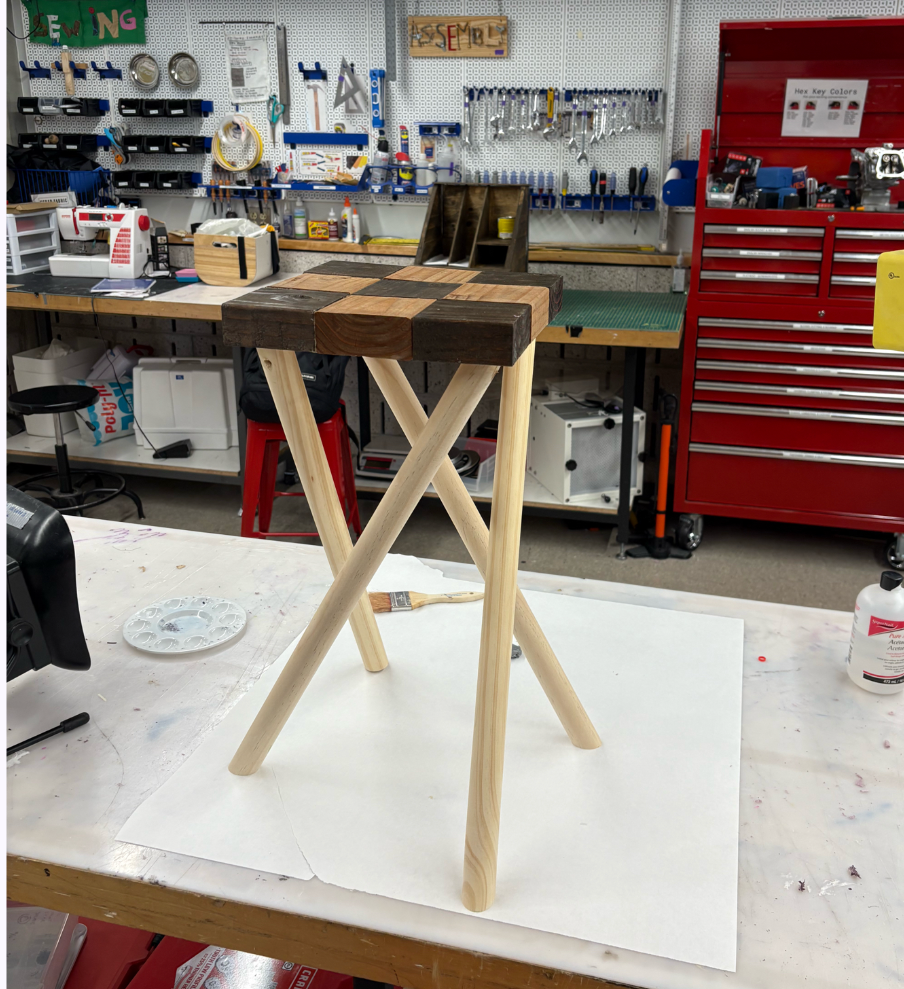
For the final project, I decided to revisit my brutalist-inspired side table. I was not fully happy with the finish of my first version, so I wanted to use the skills and techniques I learned throughout the year to give the project another shot. Instead of completely starting from a new idea, I chose to improve on my original concept and make a cleaner, more polished version while still keeping the geometric style that I liked from the first table.
One of my first design changes was making the tabletop out of wood instead of metal. I still wanted to use the idea of cut cross sections as the surface of the table, so I cut nine square pieces from a 2×4 and arranged them into a tabletop pattern. I completed the cutting, gluing, and staining process in the ITLL woodshop. Using wood gave the project a warmer and cleaner look compared to the original steel tabletop, while still keeping the handmade, block-like design.
For the legs, I used wooden dowels and a bit of trigonometry to create the illusion of angled supports. I wanted the table to look more dynamic and intentional rather than just having straight vertical legs. Figuring out the angles required some planning because the legs needed to support the tabletop while also matching the visual style I was going for. This part of the project helped me connect design, math, and fabrication in a practical way.
Overall, I am much happier with this final version of the side table. Revisiting the project allowed me to reflect on what did not work the first time and improve it using new skills I developed throughout the course. This project gave me more experience with woodworking, measuring angles, gluing, staining, and refining a design after an earlier attempt. The final table felt more complete, functional, and polished, while still keeping the creative idea from my original project.
Here is the link to the full journey and documentation on Unrulr.
