Tell Me You’re an Electric Car
Background & Historical Context
Electric vehicle design has become a defining visual language in modern cities, showrooms, and concept spaces. Emerging in the early 2010s and accelerating in the 2020s, it reflects a shift toward futuristic minimalism, efficiency, and technological clarity. EVs communicate innovation through clean surfaces, simplified forms, and controlled geometry.
For this project, we were tasked with designing a front end that clearly reads as an electric vehicle without explicitly stating it. The model was built at 1/4 scale using cardboard, forcing us to rely entirely on form, proportion, and surface treatment rather than materials or branding.
Key characteristics:
- Clean, simplified geometry with minimal visual clutter
- Reduced or eliminated grille, replaced by solid surfaces
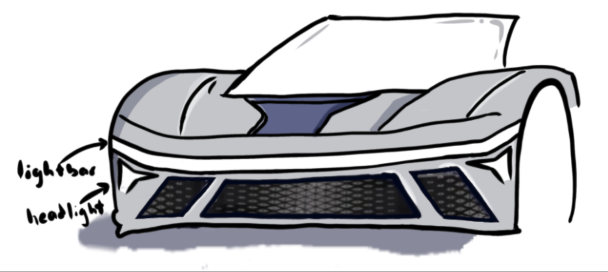
- Lighting as a defining feature, including continuous light bars
Electric car design reflects a broader shift toward sustainability and advanced technology. Influenced by consumer electronics and aerodynamics, it prioritizes integration, clarity, and efficiency over traditional mechanical expression.
There is also a psychological aspect to EV design. The same qualities that make them feel advanced can also feel unfamiliar. The lack of engine noise and highly controlled surfaces can create a sense of detachment, resulting in a “clean, but distant” aesthetic. In this way, EV design communicates both progress and disconnection.
Design Process
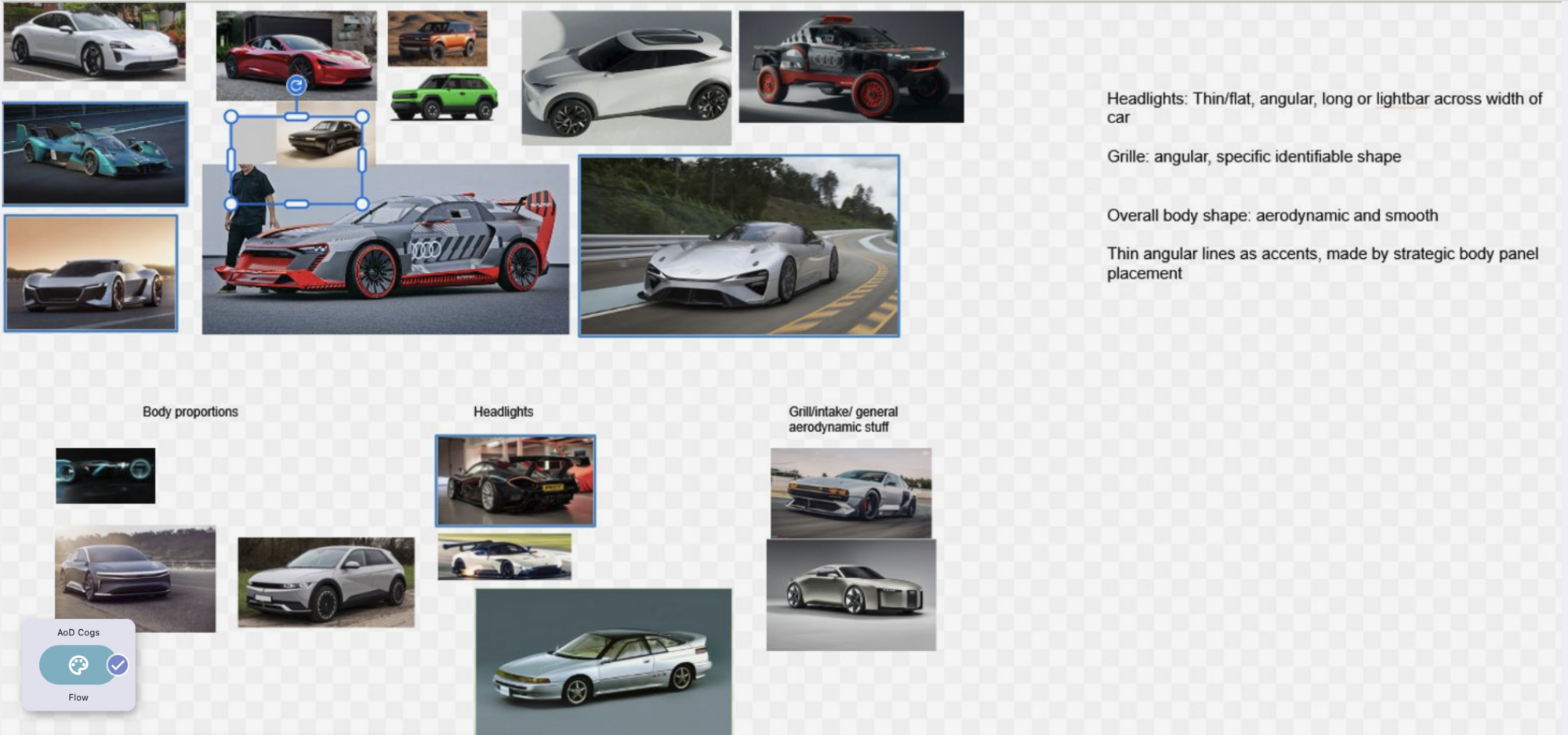
We began with a themed board to break down the defining elements of electric vehicle design and guide the direction of our concept.
After identifying key characteristics, we developed a series of sketches to explore different directions. Through iteration, we refined the ideas and ultimately selected a concept that best captured the EV design language, focusing on a strong front identity, clean surfaces, and a continuous light feature.
Bending Scrap Acrylic
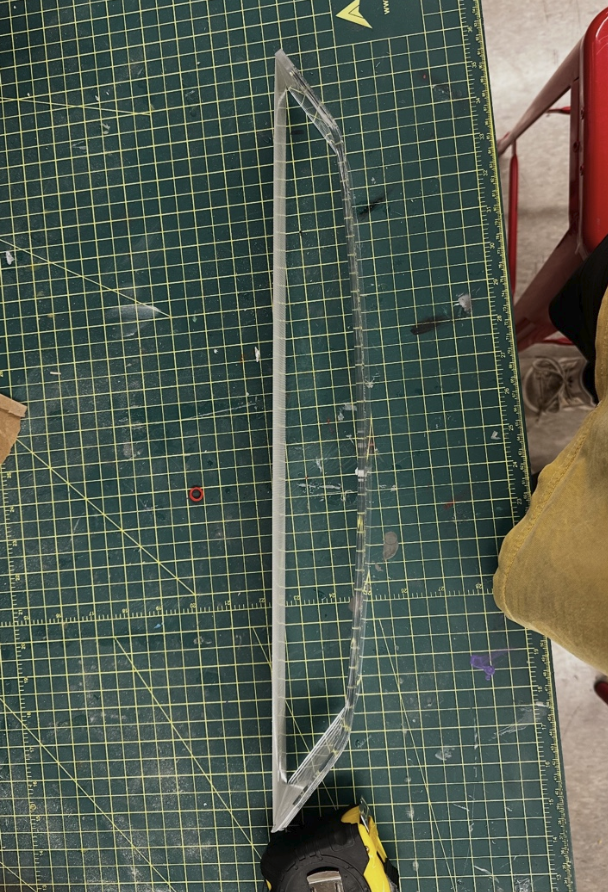
To create the light bar element, we used a scrap piece of acrylic and applied heat to bend it into a smooth, continuous curve. This process required careful control. Too much heat caused distortion, while too little risked cracking.
We worked gradually, applying heat evenly and shaping the acrylic in small increments to maintain a clean, consistent curve. Once cooled, it held its form and became the defining feature of the design, acting as a physical representation of the continuous light bars commonly seen in electric vehicles.
Laser Cutting Cardboard
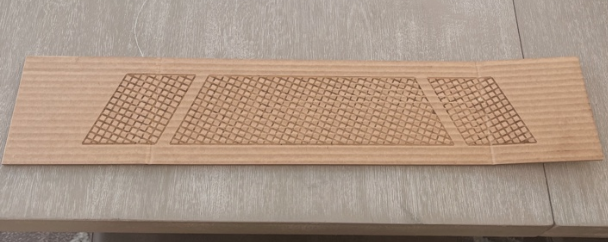
To achieve a sharper and more aggressive front-end expression, we used laser cutting to introduce precise geometry into the cardboard.
This allowed us to create clean edges, defined openings, and controlled layering that would not have been possible by hand. We used depth and negative space to build out the grille and headlight regions, giving the model a more intentional and engineered appearance.
This step transformed the model from a rough form study into something with a clear and cohesive design language.
Building and Refinement
The model was constructed through layered cardboard, starting with a rough structure to establish overall proportions. Early builds focused on stance and balance, ensuring the width, height, and front geometry felt correct.
As the design progressed, additional layers were added to refine surface transitions and approximate curvature. Because cardboard naturally resists smooth forms, surfaces were broken into smaller segments and carefully aligned to maintain clean edges and consistent geometry.
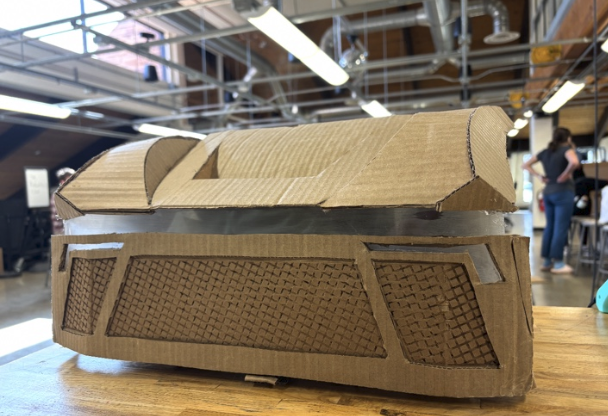
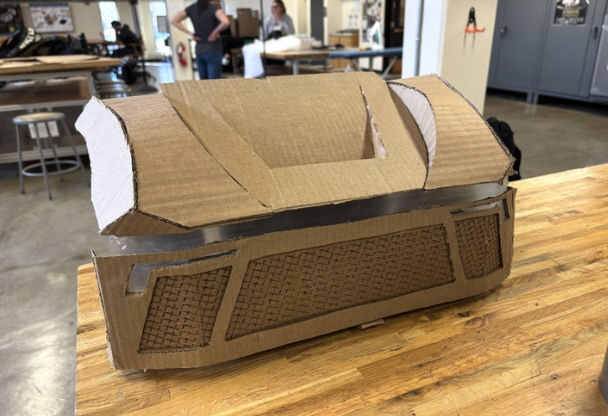
The final assembly focused on refining alignment and cohesion. The acrylic light bar was positioned first, and the surrounding structure was adjusted to frame it. Small corrections were made throughout to maintain symmetry and clean transitions.
Final Reflection
This project was a study in translating a 2D concept into a 3D form using simple materials. It required balancing speed, iteration, and precision while working within material constraints.
It reinforced how strongly proportion, surface control, and small geometric decisions influence the overall perception of a design. Even at 1/4 scale and using cardboard, the final model clearly communicates an EV identity through form alone.
Here are the final results.