
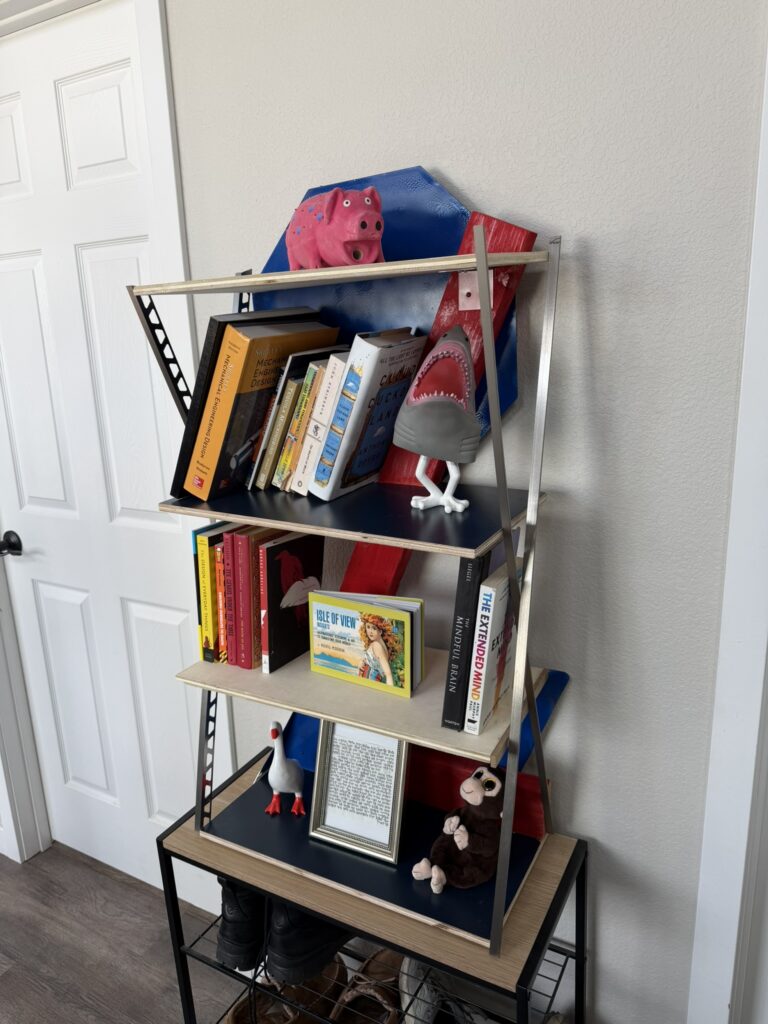
re/strata: A Constructivist Bookshelf
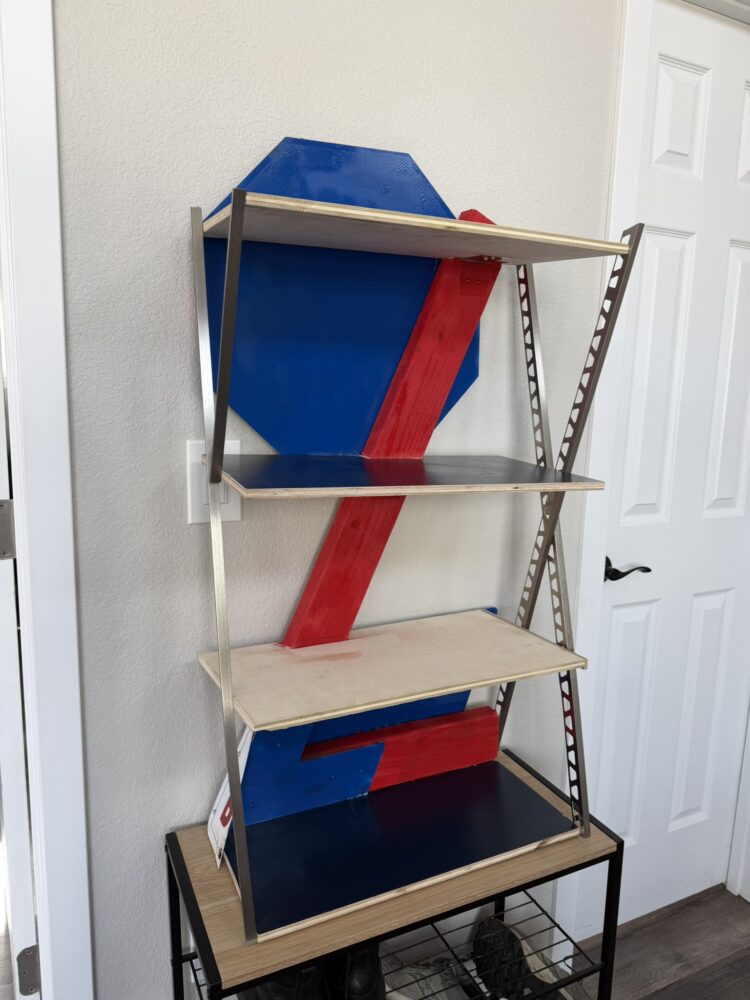
Fig. 1 – re/strata, unloaded. Against wall, view from slightly left of center.
Constructivism is an early twentieth-century art movement that originated in Russia, emerging alongside the rise of socialism and the modernization of post-Tsarist society. Rather than treating art as something purely decorative, Constructivist artists aimed to merge art with industry, engineering, and everyday life. The movement emphasized functionality, structural honesty, and the use of industrial materials. Visually, Constructivism is defined by bold geometric forms, strong diagonals, limited color palettes often featuring primary colors, and materials such as steel and concrete. Architects and designers like Aleksandr Vesnin and Konstantin Melnikov translated these ideas into built form, influencing later movements such as the Bauhaus.
This project began as an exploration of those principles through furniture. My goal was to design and build a wall-mounted bookshelf that embodied the Constructivist aesthetic while incorporating reclaimed materials. The primary inspiration came from Melnikov’s Intourist Garage, particularly its clear structural logic and strong geometric presence. From the beginning, I wanted the bookshelf to feel dynamic and industrial, yet still functional and lightweight.
The process started with hand sketches that established the core composition: stacked shelves intersected by bold structural elements and anchored by a rigid back plane. I then translated the 2D concept into SolidWorks to clarify proportions, material quantities, and structural relationships. Modeling the design digitally helped me determine how much lumber and sheet material I would need and allowed me to test different support strategies. I explored two girder options: a single continuous flat bar spanning all shelves or individual segments between each shelf. The final decision depended on material availability.
Material sourcing was central to the project. I visited Eco-Cycle to gather reclaimed components, including a 2×4, plywood panels, metal trim, steel corner brackets, and fasteners. I also found an aluminum road sign panel, which became the rigid back surface of the piece. This element not only reinforced the structure against racking but also reinforced the industrial character of the design. The visible mechanical fasteners were intentional. Instead of concealing joinery, I emphasized it to align with Constructivist ideals of structural clarity and honesty.
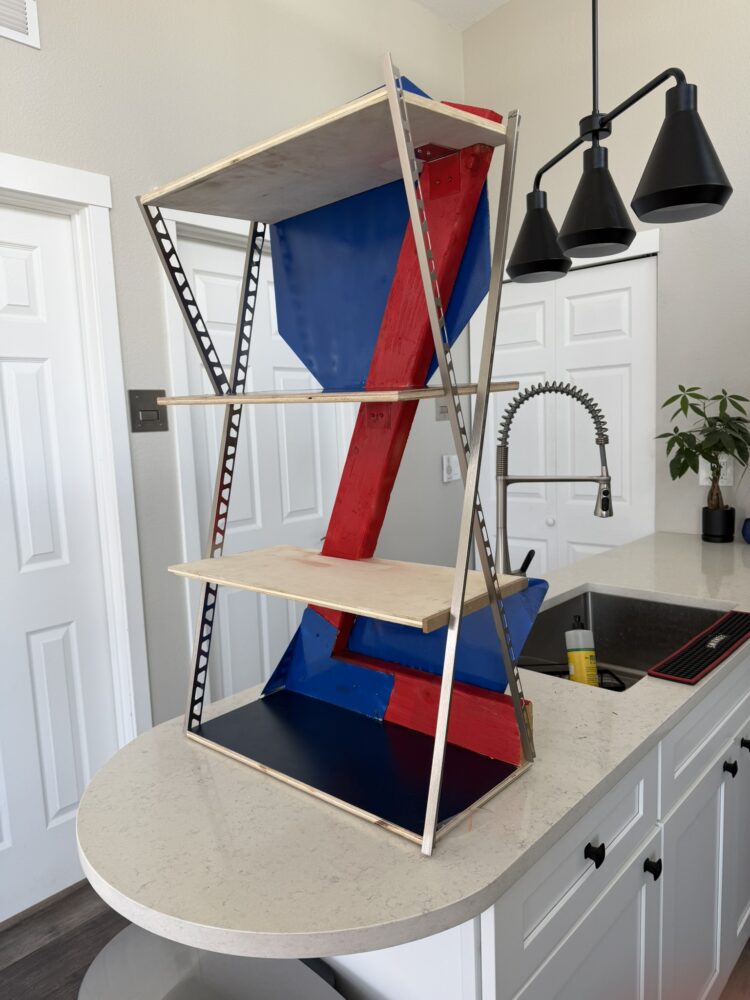
Fig. 2 – re/strata elevated on counter, view from slightly right of center. Displaying visual lightness of piece.
Fabrication began at the ITLL woodshop with cutting the plywood shelves and preparing the angled back brace. One early mistake was failing to model the shelf slots in CAD. As a result, I had to mark and cut them manually. Attempting to tape three shelves together and cut them simultaneously led to shifting pieces and a bandsaw blade derailment when backing out of curved cuts. After adjusting my approach and making controlled straight cuts, the process improved significantly. Interestingly, once installed, the slots provided more lateral support than I anticipated, especially when weight was applied to one side.
Assembly required patience. I laid the structure flat to keep brackets plumb and used a level and square to align each shelf before fastening. The process was slow, and a few extra holes reflect minor miscalculations, but the final alignment is clean. The reclaimed metal trim I sourced turned out to be a corner extrusion rather than perfectly straight flat bar, so I had to bend it slightly to fit. However, I was able to use the entire aluminum sheet for reinforcement, which felt like a success from an upcycling standpoint.
There were some connection challenges. Trim screws caused splitting in the plywood end grain and limited fine adjustments, so I switched to trim nails and drilled through the braces instead. While the structure is very solid and exhibits almost no side-to-side flex, I am aware that end-grain fastenings may not perform optimally under extreme loads. In future iterations, I would incorporate notch lap joints between shelves and frame members to improve alignment and increase structural integrity. I would also paint components prior to final assembly and potentially use a continuous metal rod system for brace connections.
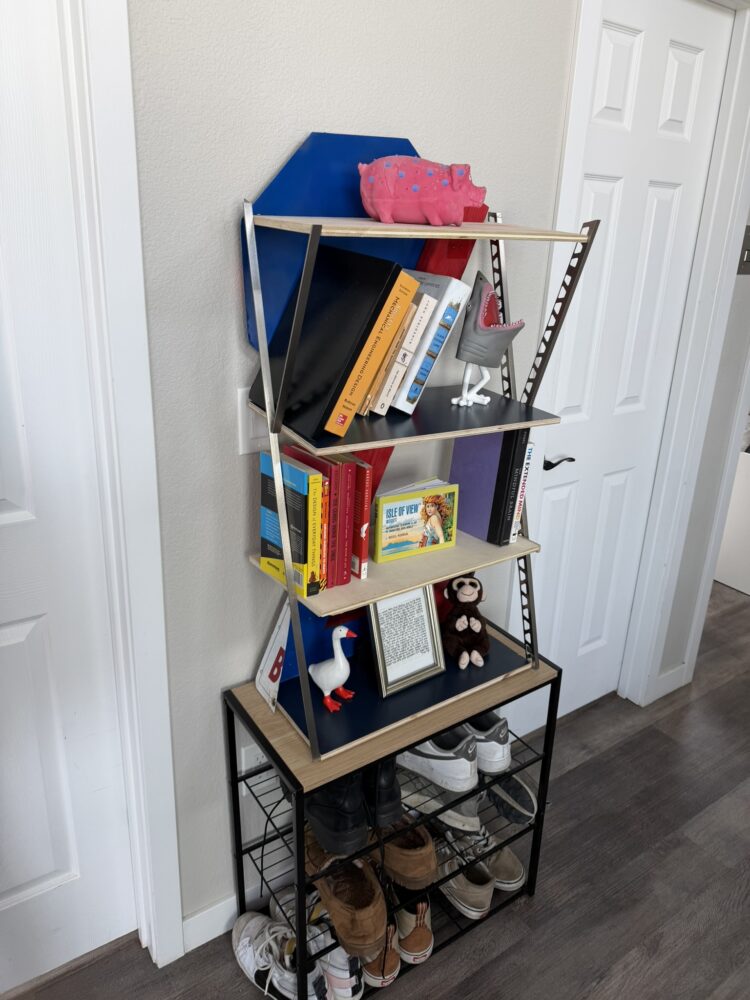
Fig. 3 – re/strata in use, loaded with items. Against wall, view from slightly left of center.
The finished bookshelf, titled re/strata, reflects Constructivist principles through exposed steel supports, bold red and blue planes, and clear load paths. One of its strongest qualities is its visual lightness. Unlike most bookshelves, which appear bulky from the side, this design feels open and airy due to the slender metal supports and minimal framing. The vibrant colors give it energy, while the reclaimed materials ground it in practicality and sustainability.
Overall, this project reinforced the importance of planning while also highlighting the realities of fabrication. While CAD modeling provided clarity, hands-on problem solving was just as important. The workflow remained steady, with only minor pauses to address unforeseen challenges. re/strata ultimately succeeds not only as a functional bookshelf but also as a constructed composition, translating early twentieth-century industrial ideals into a contemporary, upcycled form.
Additional information and progress pictures available at:
Unrulr Post
