
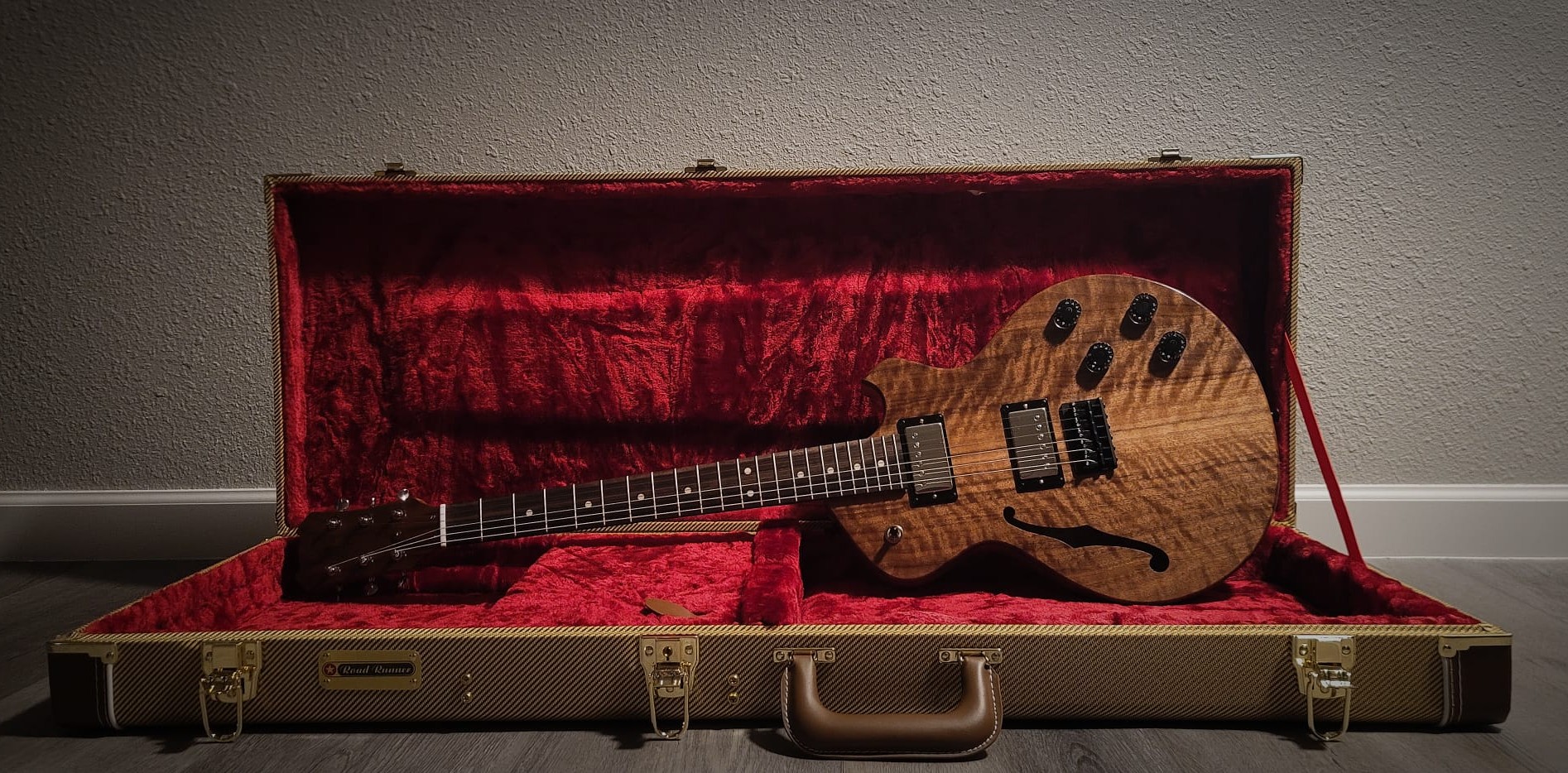
They said I could make anything I wanted…
 I’ve been playing the guitar for about 10 years now. That is, only about 10 years now. And in that time, I’ve played almost exclusively acoustic guitars as aligned with the majority of my musical interest. Getting into electric guitars, for as long, has only been a backburner desire that demanded much time and effort into deciding just what guitar I’d enter that world with – time and effort I didn’t have to spare.
Another backburner desire I’ve held for about as long has been to develop real skills as a woodworker. Specifically, I hoped to one day have a garage with enough tools to learn how to make a guitar myself – and play it for a very long time.
They said I could make anything I wanted, in a for-credit class, and that I could make it with any of the tools and resources available on the University campus. So, I learned how to make my own custom electric guitar from the bottom up.
Learning & Inspiring
At the onset of this idea some six months ago, I could barely tell the difference between a Stratocaster and a Telecaster – some of the most iconic electric guitar designs since their commercial popularization in 1951. So my ideation began with learning the major makes and models of electric guitars in the last 75 years and figuring out what I liked most (or least) about each of them. As diverse as electric guitars can be, I found that those designs I most favored were tied to my acoustic roots. The most beautiful designs are those that favor their acoustic ancestors whose shapes were driven entirely by the sounds they were meant to produce.
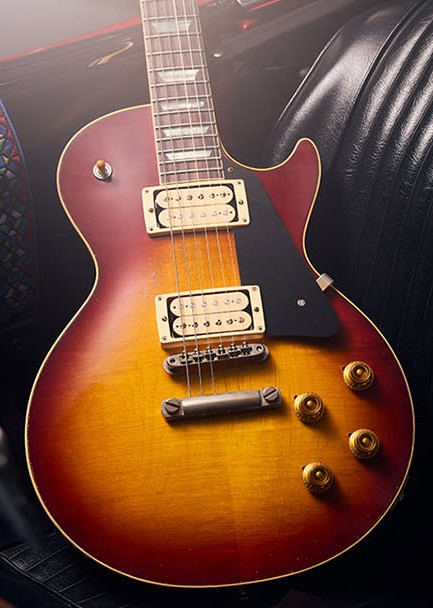 Among modern electrics (excluding archtops, which blur the line between acoustic and electric instruments), the shape most favoring that of an acoustic guitar is the Les Paul (1, right). An especially round lower bout is the most obvious feature, and the upper bout would be a smaller mirror image if not for a tasteful cutaway allowing the player easier access to the highest frets. Their symmetrical headstock (2, below) also favors the majority of acoustic designs, where Fender’s Tele and Strat headstocks broke that pattern with their asymmetric headstocks. Symmetric headstocks compliment a symmetric body, where asymmetric designs compliment likewise.
 The Les Paul’s shape, mimicking acoustically-driven guitar shapes, fits into the aesthetic I’ve set to use and taken to calling: Traditional Lutherie.
Aesthetic
Lutherie is the craft of luthiers – makers of stringed musical instruments (and in this context, guitars). While luthiers are now able to make a wide variety of guitars in their shapes, colors, configurations, etc., “Traditional” Lutherie highlights the natural appeal of instruments that have been crafted for centuries. This includes acoustically-driven shapes, even if the shape is no longer essential to instrument functionality. It also avoids heavy coloring in paint or varnish, making use of natural tones inherent to the wood. 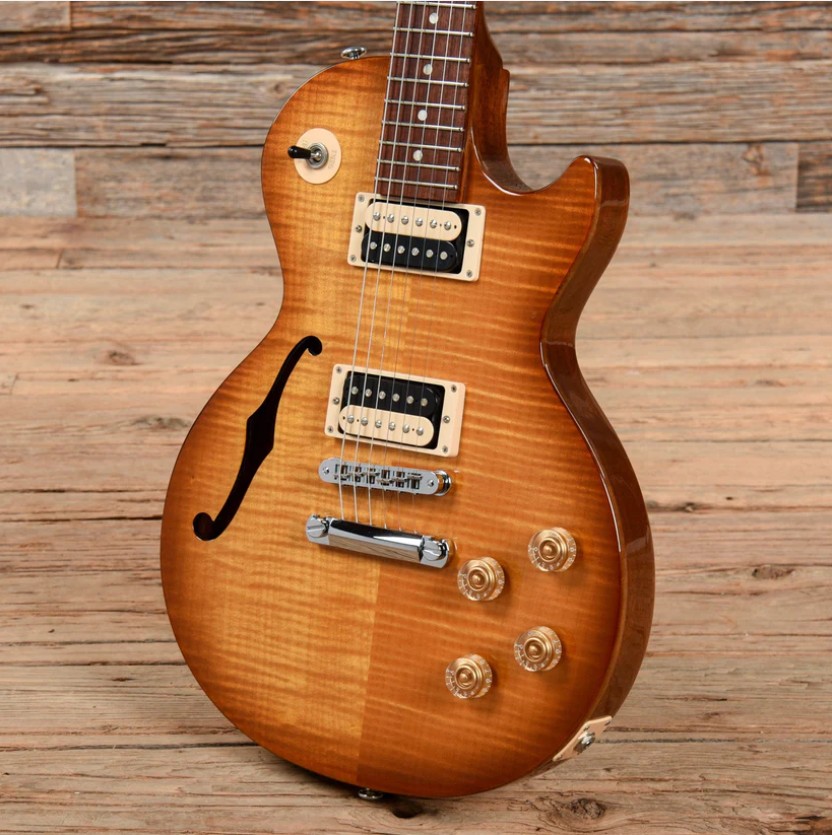 And inherent to the wood also is its grain, organically beautiful and variant in pattern. Wood grains are thus left exposed and/or highlighted as best as possible to emphasize that natural beauty of the instrument’s own medium. Certain craft features are likewise traditional to luthiers, such as the the F-shaped sound hole commonly seen on violins, cellos, or even archtop guitars. Gibson made a few Les Paul specials as pictured (3, right) that fit well into this aesthetic and served as a pivotal inspiration for my own design.
Apart from the aesthetic appeal of Traditional Lutherie, instruments embodying the characteristics above say something about the tender love and care taken in their creation. Brightly colored (or even extremely dark) and audaciously shaped guitars may have their own contextual appeal, but organic shapes with natural tones seem to say, “This took time and craftsmanship.” It’s unlikely I’ll ever reach a master craftsman status, but I wanted my guitar to at least hint at the time invested and skills merely cultivated through a project that was ceaselessly exciting to work on.
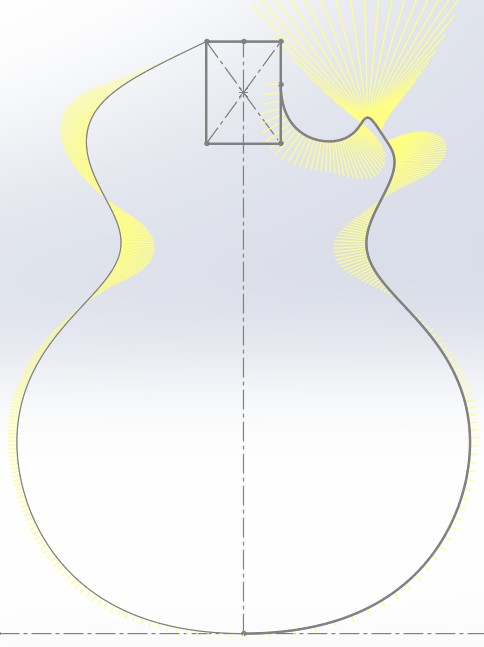
I started my design in CAD, creating predominant shapes and using it to visualize the placement of hardware. Ultimately and during construction, the design was completely empirically. I made decisions as I went, having the instrument in-hand and gaging how it might feel to play when considering feature and hardware placement. As such, these models served as a start, but the complete and final design is only the physical one.
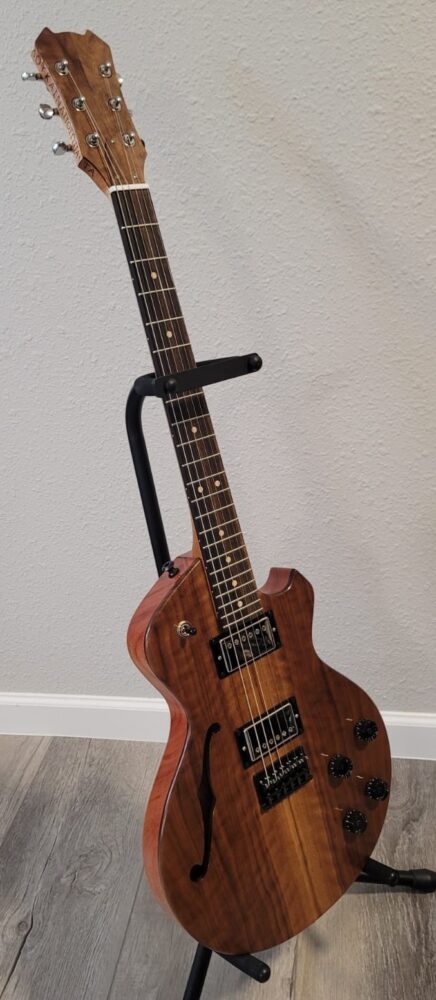
The Extol Custom Electric Guitar
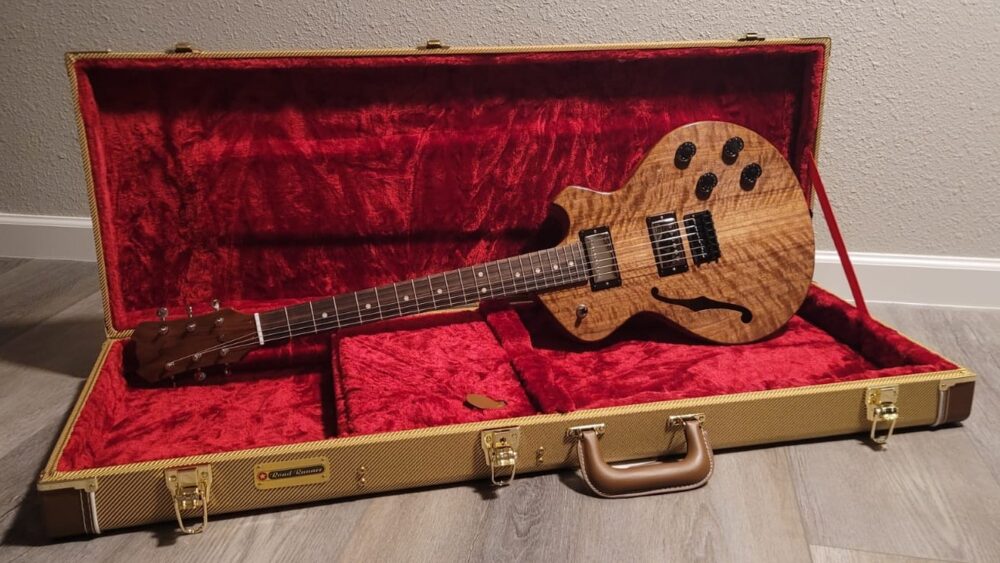
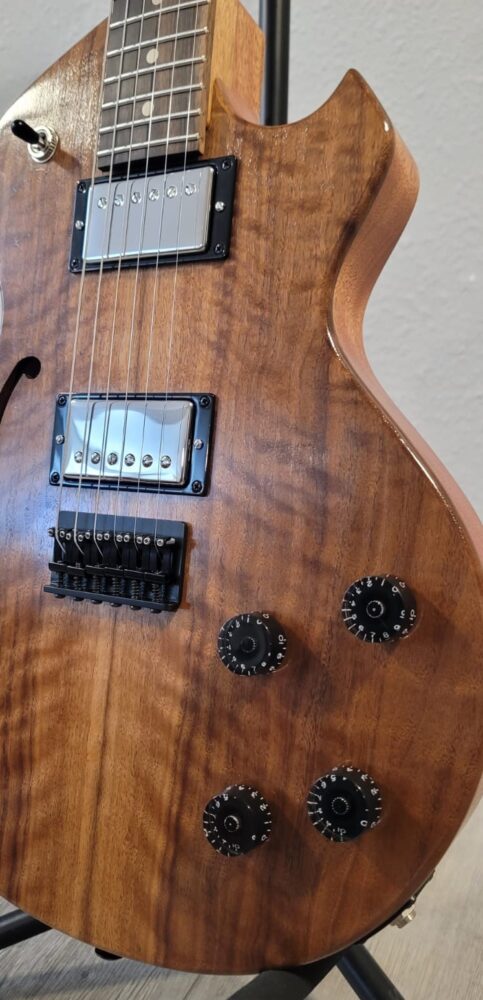
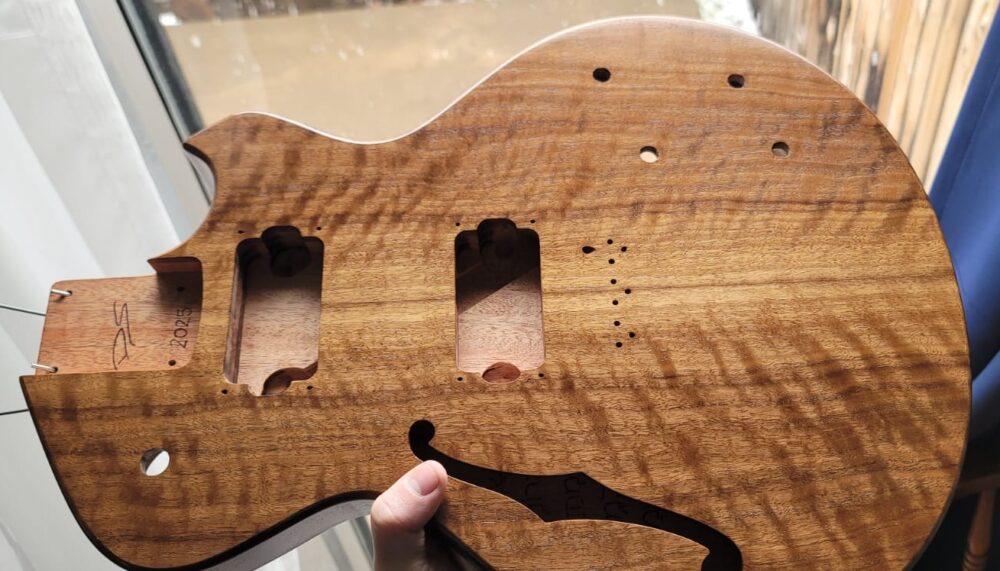
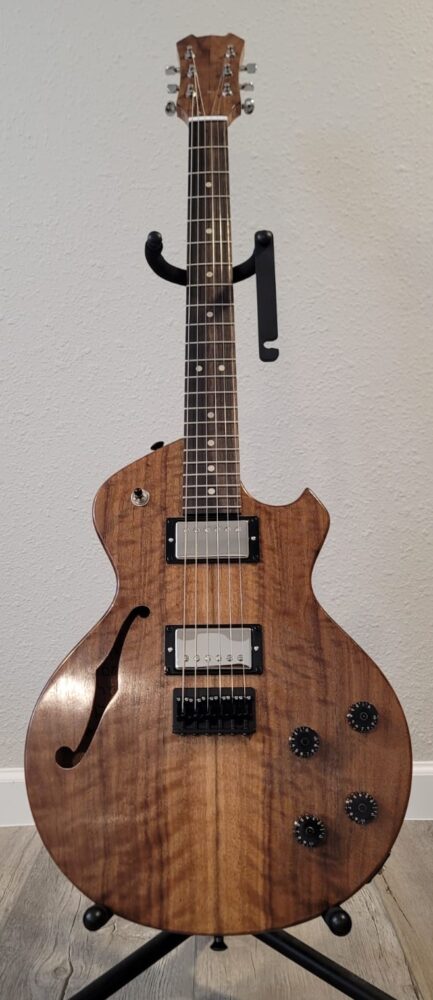
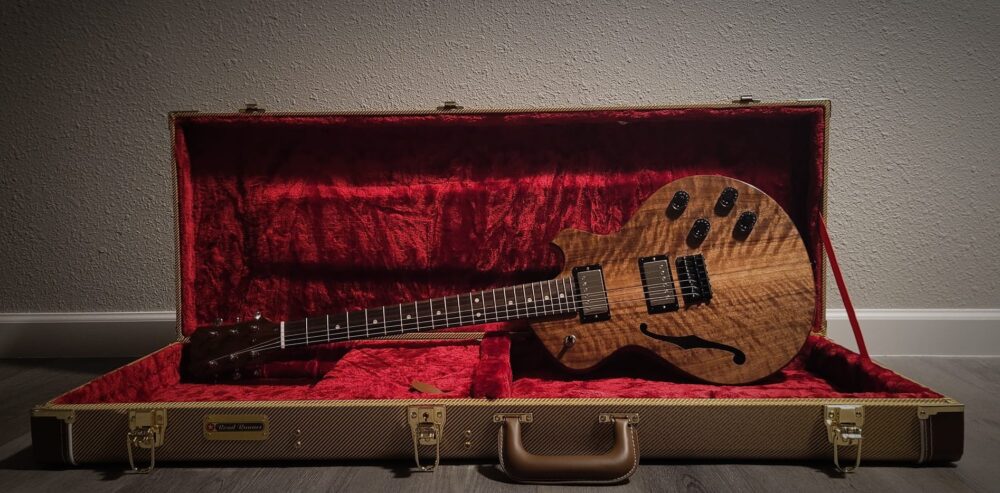
My design is made of flamed black walnut set atop a hollowed African mahogany body. The neck is also mahogany with an ebony fretboard and black walnut veneer atop the headstock. I used bookmatched walnut to create a near mirroring grain pattern about the guitar’s center seam. With some varying color in the walnut I received, I opted to join the edges with milkier tones in the middle and produce a “stripe” of paler walnut straight down the center of the body. This also moved the majority of the flamed grain front and center, which I oriented in an “A” pattern (as opposed to “V”) so that the grain would appear to flare off from the centerline and neck – as if the fletching of an arrow or waves cut by the bow of a ship.
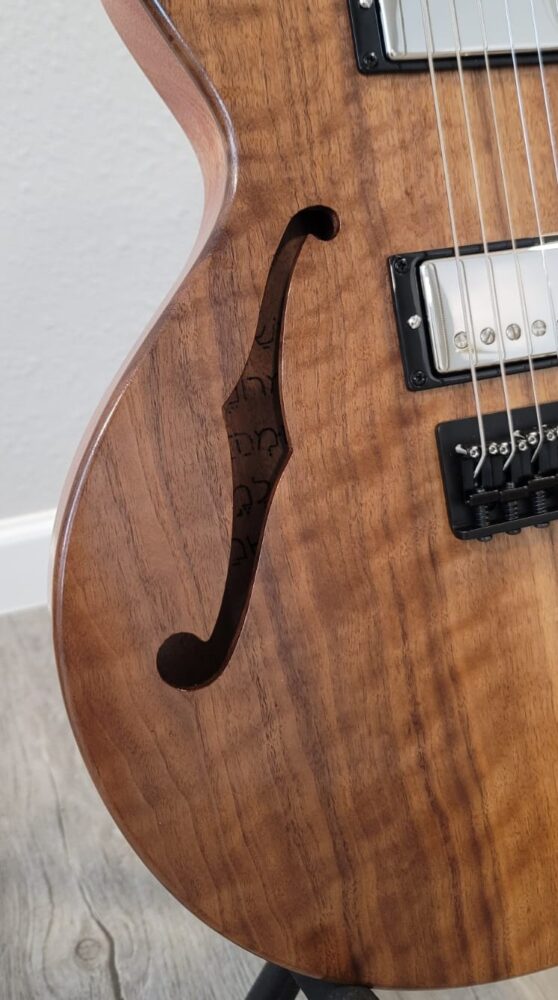 An obvious feature on the walnut top is a single F-hole on the player side of the lower bout. I opted for a single F-hole first because I appreciated it stylistically on the Gibson Les Paul Special that came from my inspiration. It does a lot to look “traditional” without doing too much. Second, I didn’t want an opposite sound hole lest it start to look too much like an archtop guitar. If it did look like an archtop, the guitar would only appear “fake”, where the single F-hole makes clear it’s meant to be purposeful and stylistic, not trying to be a style of guitar that it’s not, fundamentally.
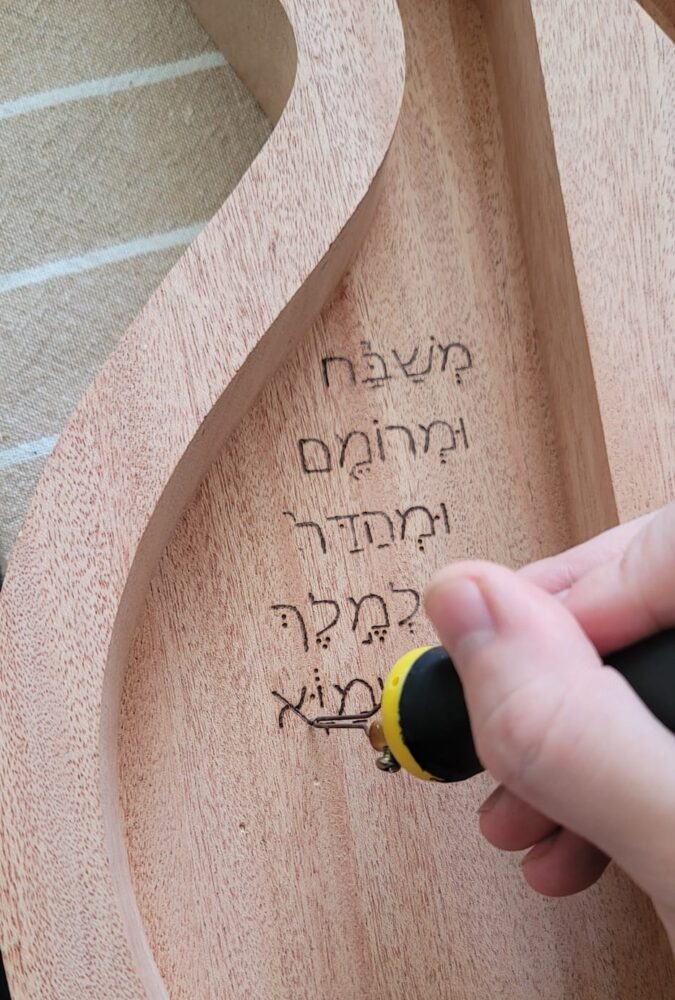 Behind the F-hole, visible only on closer inspection, is one of my favorite features of the guitar. Before gluing the top of the guitar, I used woodburning to darken and engrave the mahogany’s inside with five words written in ancient Hebrew. They read “praise and extol and honor the King of heaven”. This instrument, like its player, is meant for worship. Words of praise emanating from the sound hole are an artistic metaphor for this purpose
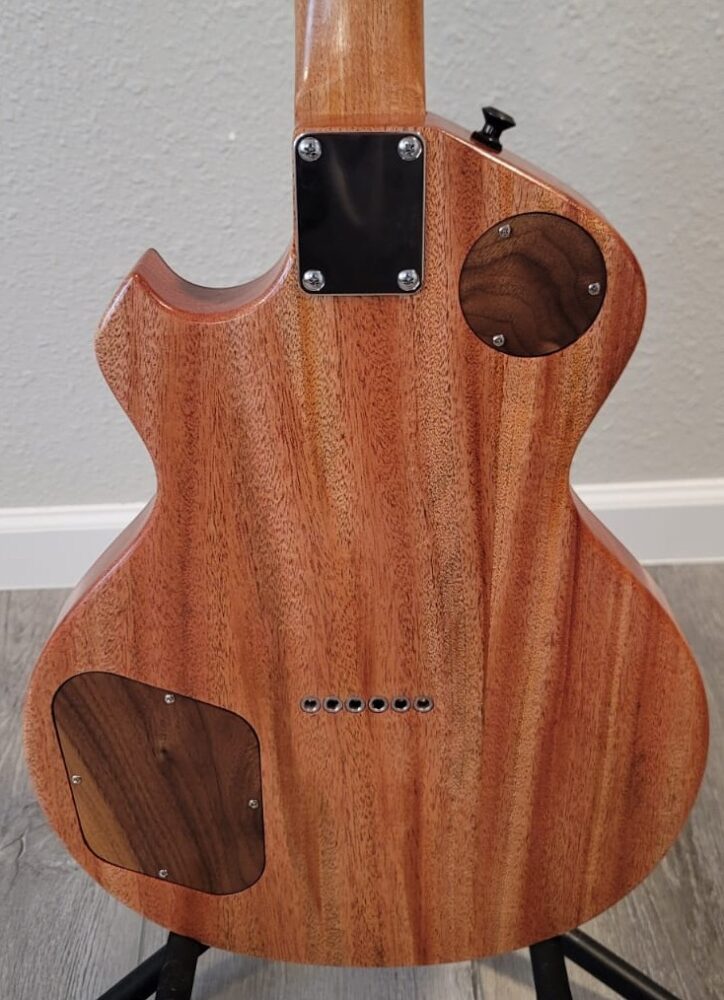 Mahogany is an excellent and easy wood to work with in guitar making, and the orangish-brown color of the blank I got compliments the walnut perfectly. This mahogany back was easily cut and routed and served as the driving component for the guitar’s overall shape.
I also opted to use walnut to create covers for the back’s electronics control cavities. Though darker walnut contrasts against mahogany, I decided the contrast was tasteful and complimentary to a predominantly walnut top and headstock.
I designed the shape myself and eventually laser cut clear acrylic templates to guarantee the cuts were perfect. The lower bout, like a Les Paul, is nearly circular just as acoustic guitar designs required for proper sound. Instead of making another rounded bout at the top, I brought it down to an angle that meets the neck from below and falls in line with the “fletching” angle of the flamed walnut grain.At the cutaway, I designed curves to smoothly and organically meet a perfectly flat surface at the end of the cutaway horn. I didn’t want it to be sharp and “evil”-looking, but I wanted to incorporate the flat edge I’ve not seen on any other guitar designs. I played with the style curve in CAD until it finally struck me as “the one”. This cutaway shape then became one of my favorite parts of the whole design.
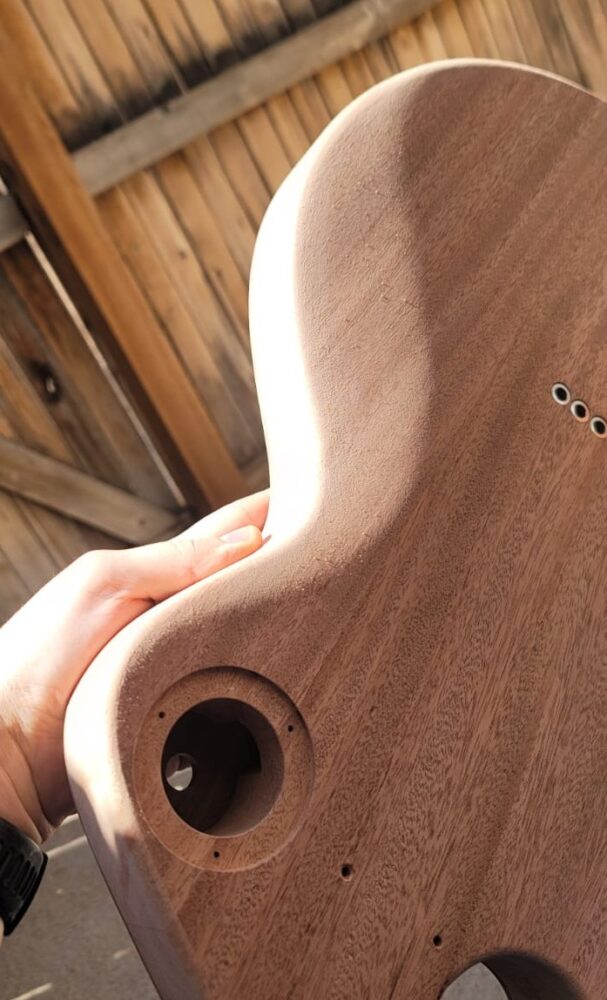
To improve ergonomics and playability, I added a shallow “belly cut” to the mahogany’s midsection where it rests against the player’s torso. The perimeter edges of the body are also filleted to 3/16″ for both a softer appearance and smoother edge to rest an arm on.
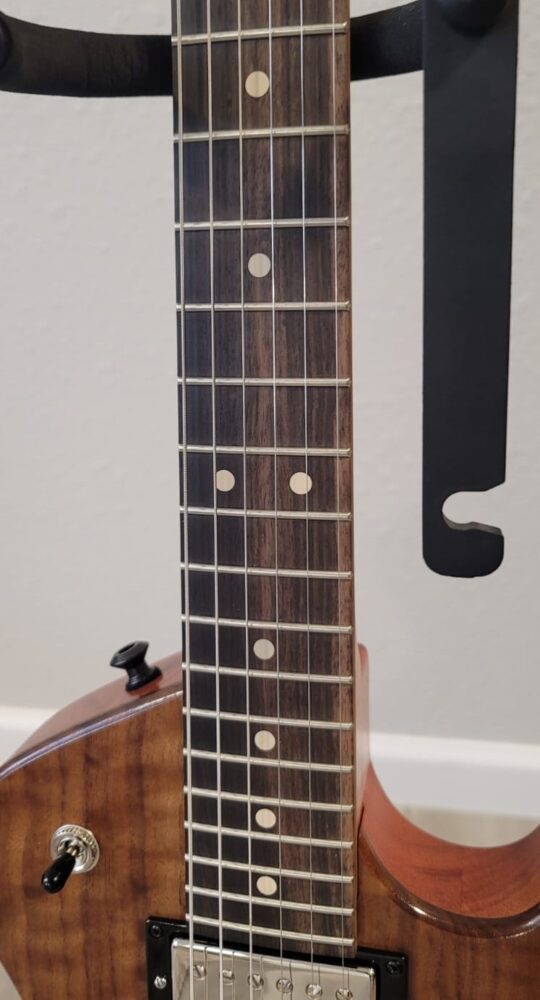 Ebony is best for a fretboard because it’s a very hard and durable wood, and the fretboard constantly has metal strings being pressed against it. The ebony fretboard I received matches the tone of this guitar perfectly as it came with milky tones all along the right edge (or “lower edge” as seen when playing) that mimic the hues of the walnut. I purchased the neck from Warmoth in order to guarantee two things: 1. Playability, as a messy first attempt at a fretboard would render the guitar unplayable; and 2. Building time, as ensuring completion required a very early start even without this highly technical operation.
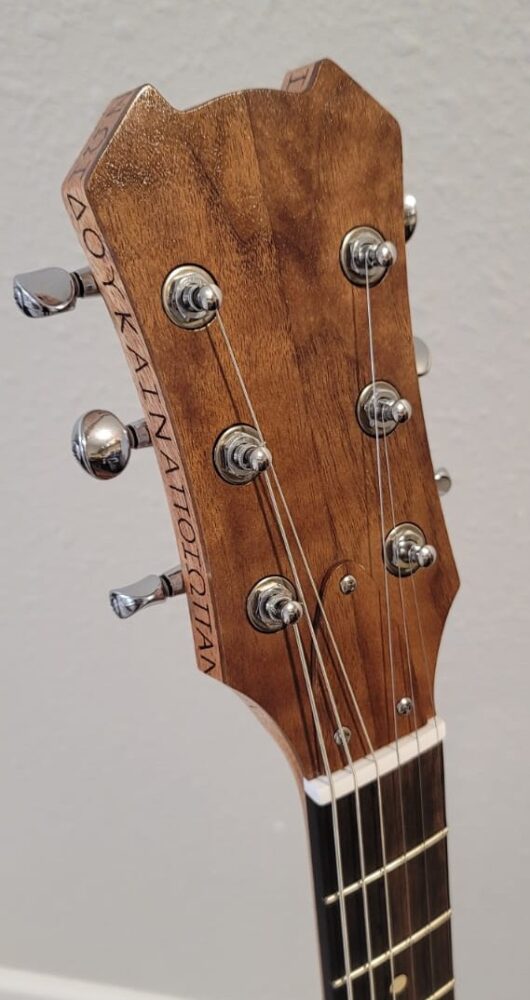 I also designed my own tilt-back headstock. These are notoriously difficult to do tastefully because they have to be aesthetically pleasing on two fronts: On their own as a single entity and as a compliment to the guitar’s body. As such, it takes as much time to design a headstock as it does the shape of the body. Go and Google guitar headstocks or try sketching an original one, and you’ll see what I mean.
My headstock has sharp lower corners and a “waist” that curves slightly inward much like the Les Paul. The top, however, features two points that apex inward before retreating to a soft curve over center. These two apexes are copies of the cutaway horn on the guitar’s body below, pulling that defining feature upward to bring the whole design together. The walnut veneer placed over the headstock is cut from the same walnut used for the the body.
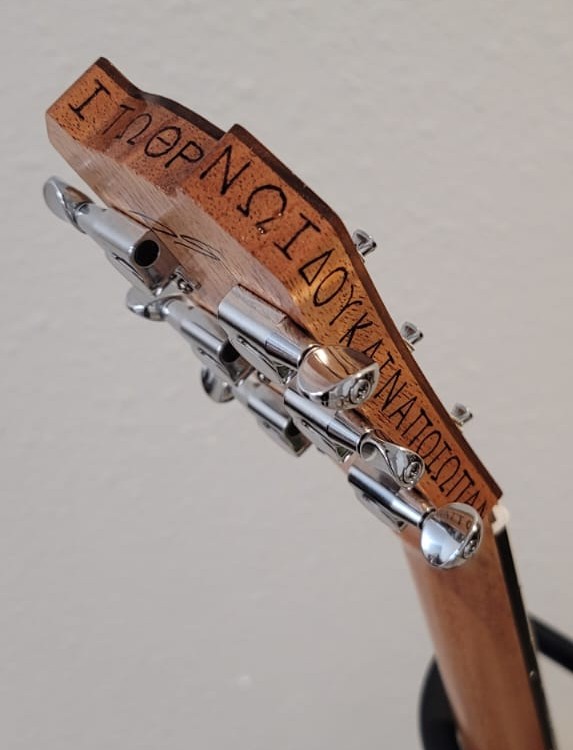 Around the headstock, I took more artistic liberty to woodburn an inscription in ancient Greek, also from the Bible. The words are from Revelation 21:5 and are translated: “And he who was seated on the throne said, ‘Behold, I am making all things new.'” These words of Jesus, for the Christian, are both a hope and a testimony.
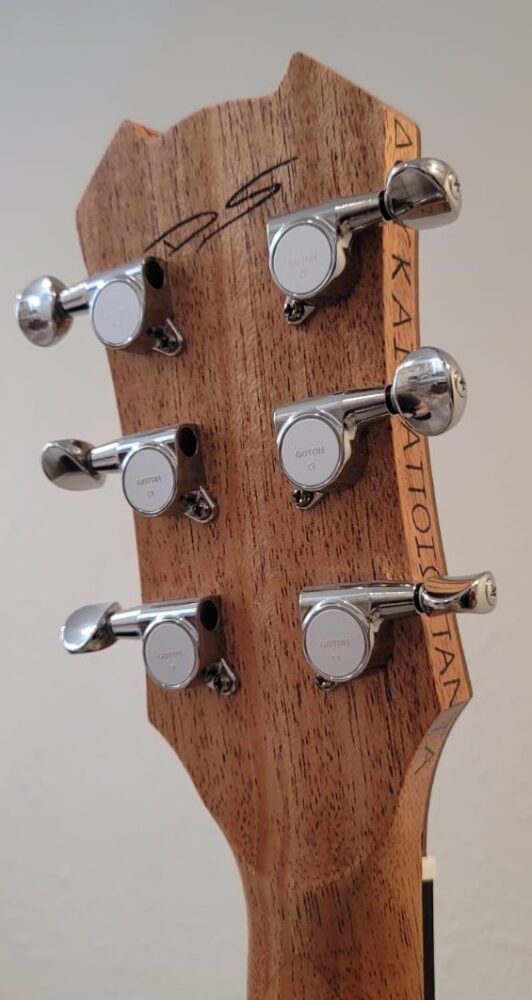 Since creating a custom inlay was outside the realm of possibilities for this project, I decided to woodburn a “logo” – that is the signature I put on any artwork I complete – on the back of the headstock above the tuning knobs. Placement back here is meant to be subtle, prompting a viewer to be curious why the headstock is blank and thereby look closer to find the writing around its perimeter. The signature is a set of initials, “DS”, for my family name.
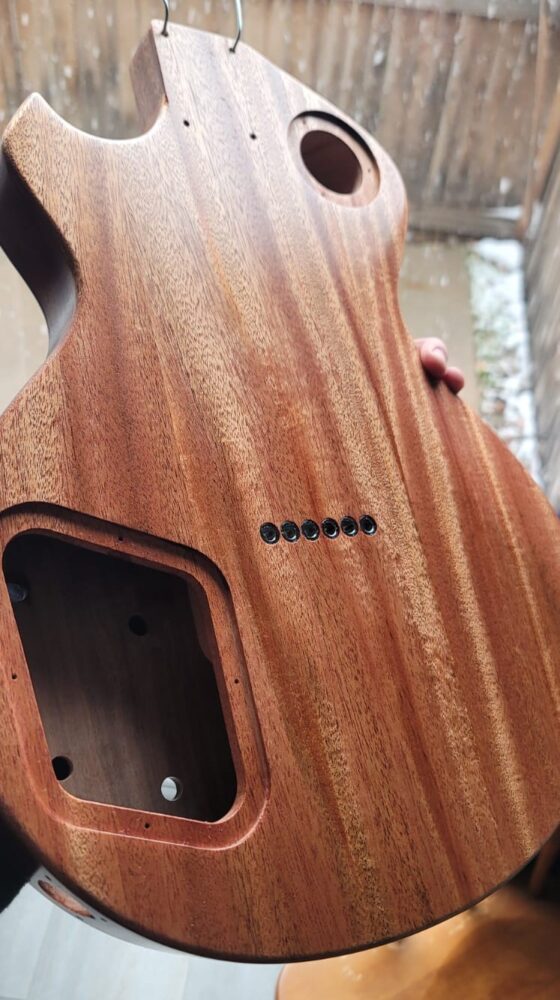 The entire guitar was finished using Tru-Oil gunstock oil from Birchwood Casey. It’s an easy-to-apply finish if you’re patient to add as many layers as is necessary, and it’s much thinner than other finishes like lacquer. It’s also a penetrating oil that seeps into the grain to carry light through and make the flaming in the walnut beautifully vibrant. A slight yellowish hue in the oil also darkened the walnut and mahogany perfectly to match the color tones I’d hoped for at this project’s conception.
The guitar itself is a flat top design, therefore without need for a neck angle. It uses a 24 and 3/4″ scale similar to that of Gibson Les Paul designs. This scale is slightly shorter than Tele or Strat designs and, supposedly, easier to play. The bridge saddles are narrow-spaced to be compatible with two Seth Lover PAF humbucker pickups (bridge and neck placement). The neck pickup is placed as close to the neck as possible, while the bridge pickup is a little further from the bridge than is typical, creating a slightly warmer sound. Each pickup has its own volume and tone control, making the guitar a 2-tone, 2-volume configuration with a 3-way switch and standard output jack. A combination of black and chrome metal components brightens up the appearance of the otherwise dark tones of the guitar.
Concluding Thoughts
The vision for this guitar truly came to life and continued to improve as design possibilities made themselves apparent over the course of construction. I learned more than I could’ve hoped, and I’ll be happy to display this instrument in my home when it’s not busy singing. I’m hopeful also to play this guitar for the rest of my life until I can pass it on. With lessons learned in-hand, it’s likely the itch to design another guitar will come back years down the road – and I look forward to that next undertaking with fresh ideas.
Citations:
1. Yahoo Entertainment. “Gibson Honors Jeff Beck with a Recreation of His 1959 ‘YardBurst’ Les Paul – before He Gave It a Radical Makeover,” June 24, 2024. https://www.yahoo.com/entertainment/gibson-honors-jeff-beck-recreation-124112135.html.
2. The High Gain. “Episode 62 – The Gibson Les Paul Standard,” July 10, 2019. https://www.thehighgain.com/podcast/2019/7/10/episode-62-the-gibson-les-paul-standard.
3. Chicago Music Exchange. “Gibson Les Paul Special Semi-Hollow Caramel Burst.” Accessed March 3, 2025. https://www.chicagomusicexchange.com/products/gibson-les-paul-special-semi-hollow-caramel-burst-1493376.

4 Comments. Leave new
Hi Seth,
This looks amazing! I love the finish on the wood it looks so professional great job. I love the details you added to the headstock. Do you have a favorite song you like to play?
Thanks, Mila! The finish turned out as-advertised, and I was so glad. The headstock is also one of my favorite details. Most of the songs I know are better for acoustic guitars since they’re all I’ve ever played, but I’ll be learning some new electric melodies soon.
This is absolutely incredible!!! it looks so professional and well done. On the next post would you consider posting a video of it being played?
Thanks Sylvia! I appreciate it. I’m considering a video but don’t currently have a decent amp to showcase with. If there’s opportunity soon, then yes.