

Final Report Part 2: Eye of Agamotto – The Making Process
Introduction
This post documents the complete fabrication and final reflection for my main project: the Eye of Agamotto. In Part 1, I outlined my aesthetic goals and conceptual direction. In this final report, I will walk through the process of building the artifact, describe the challenges I faced, and reflect on the results. This project ultimately became a wearable piece of fantasy design that honors the source material while staying grounded in my own creative expression.
Timeline of Work
I divided the project into several key phases and created a timeline to manage my progress. While the project stayed generally on track, I had to adjust along the way to account for design revisions and technical learning.
| Phase | Tasks | Dates |
|---|---|---|
| Exploration & Research | Sourcing model, gathering visual references | March 10–14 |
| CAD Review & Scaling | Adjusting Thingiverse file, scaling to fit | March 15–17 |
| 3D Printing | PLA print at BTU maker lab | March 18–20 |
| Post-Processing | Sanding, smoothing surface | March 21–22 |
| Wearability & Attachment | Superglue & green string necklace | March 23 |
| Mechanism Testing | Exploring built-in rotation/opening feature | March 24–25 |
| Documentation & Photography | Final photo shoot, writing blog content | April 20–23 |
Fabrication Process
1. Sourcing the Model
I downloaded the Eye of Agamotto 3D model from Thingiverse. This model was well-detailed and included a built-in mechanism for the opening faceplate, which was a big reason I chose it.
2. 3D Printing
I printed the model using standard PLA filament in black. The piece was printed in two main parts: the outer shell and the inner base. The mechanism to allow it to open was pre-modeled into the print, which made post-assembly easier.
3. Sanding & Cleanup
After printing, I carefully sanded the shell to remove small print imperfections and stringing. I didn’t paint the model—leaving the raw black PLA was a conscious aesthetic choice that emphasized the artifact’s arcane, shadowy nature. The surface still benefited from being sanded, creating a matte finish that made it feel more authentic and less like plastic.
4. Making It Wearable
To convert the Eye into a wearable object, I cut a piece of green string and superglued it to the back of the shell. This simple solution gave the prop a more personal, handcrafted quality, allowing it to be worn like a pendant or talisman. The green string visually references the Time Stone and ties the whole piece together thematically.
5. Mechanism Functionality
The Eye of Agamotto has a built-in mechanism that allows the outer shell to rotate and open slightly, just like in the films. I was excited to discover that this functionality printed cleanly and worked as intended. Though simple, this feature gives the piece a dynamic, time-based interaction that elevates it beyond a static display object.
Reflection & Comparison to Initial Vision
When I began this project, I envisioned a prop that blended elegance, magic, and mystery. I originally thought I would paint the piece gold or brass, and perhaps integrate a full LED setup. However, I ultimately found that the raw black look captured the mystical quality better than expected.
The addition of the green string not only improved its functionality (as a wearable) but also created a subtle yet effective nod to the glowing green light of the Time Stone. I still plan to add an LED inside in the future to enhance this effect even more.
The biggest surprise for me was how much the built-in opening mechanism enhanced the experience of the object. Even though it’s a small detail, being able to interact with the artifact in a physical way makes it feel more alive.
What I Learned
- Aesthetics don’t require complexity – Even with a simple color scheme and few moving parts, the Eye still has a strong visual identity.
- Less is sometimes more – Rather than over-designing or over-building, letting the object’s form speak for itself was powerful.
- Time management is key – Sticking to my timeline helped me avoid last-minute stress.
Future Improvements
- Add an LED with a diffused resin lens to simulate the glowing Time Stone
- Improve string attachment with a cleaner embedded loop or clasp
- Consider repainting in metallic finish as an alternate aesthetic version
Conclusion
The Eye of Agamotto project has been one of my favorite builds because it brought together so many disciplines: pop culture, aesthetics, fabrication, and storytelling. While the final version is simple in execution, it’s rich in meaning and intent. It represents the mystical and ancient while also feeling wearable and tangible.
I’m proud of how the piece turned out, and even more excited to potentially expand or remake it using what I learned. It’s a reminder that design doesn’t have to be perfect or overly complex to be meaningful. Now all I need to do is get a little green light to glue inside the eye for expo!
In Part 1, I Displayed Pictures of Me Superglueing, 3D Printing, and Assembling.
Final Images:
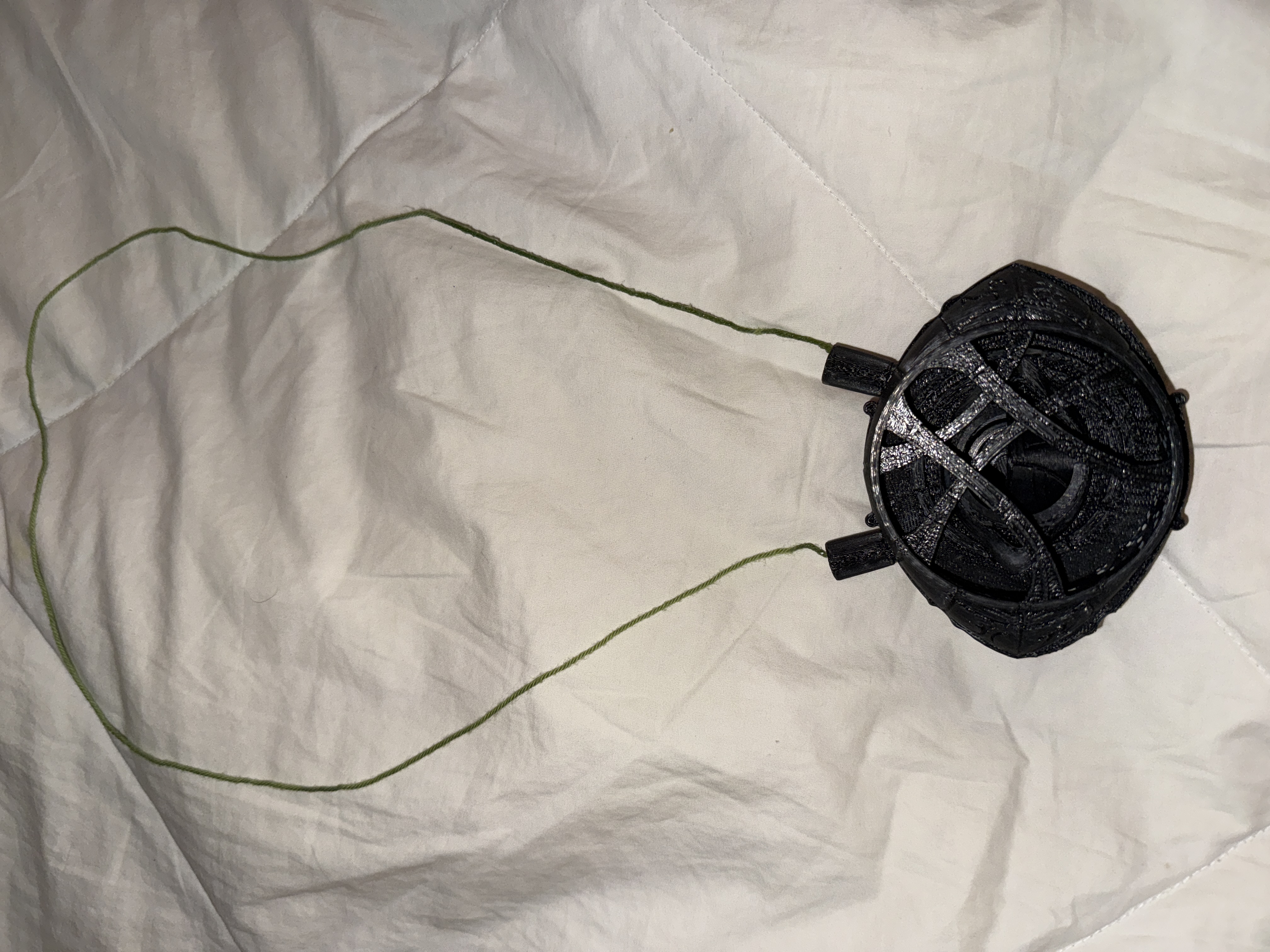


Featured Image:

Citations:
(1) https://www.thingiverse.com/thing:1929165
(2) Marvel Studios, Doctor Strange, 2016

1 Comment. Leave new
Hi Andrew,
This is a cool collector’s piece! The print came out really well!
I think when you add the LED light the whole thing will come together really nicely! Also, maybe adding a bit of gold paint to highlight how the lights hits the piece could look really cool. Did you have to add any support to the piece? If so, I think you did a great job of cleaning it up! What limitations did you come across while printing?